Understanding Vehicle Warning Systems
Modern vehicles rely on complex onboard diagnostic systems to monitor performance and
detect irregularities. These systems use sensors throughout the vehicle to track everything from
engine operation to emissions output. When a problem is detected, the system triggers the
check engine light to alert the driver.
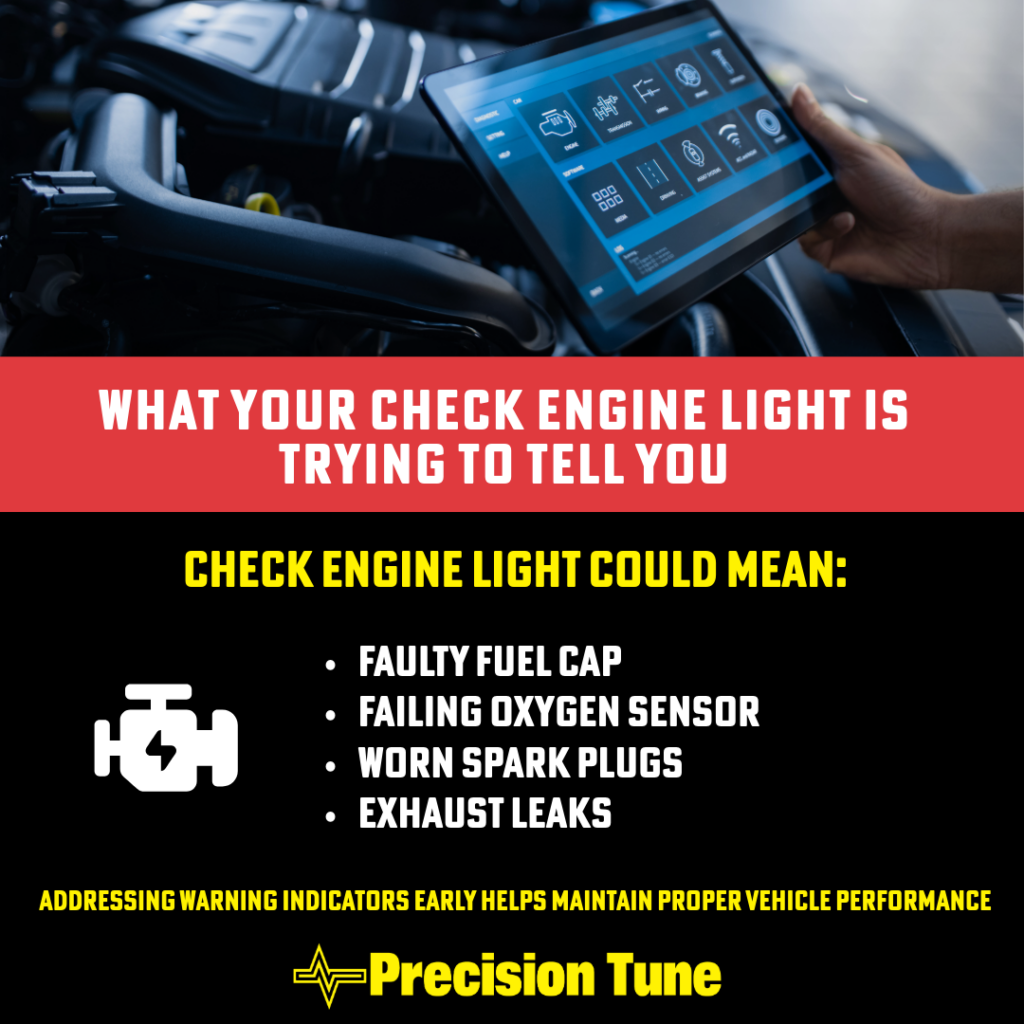
The check engine light can be activated for a wide range of reasons. Some are relatively minor,
such as a loose or faulty fuel cap, while others may indicate more significant issues involving
engine components or emissions systems. Because of this wide range, the light itself does not
specify the exact problem but signals that further evaluation is necessary.
Diagnostic tools are used to retrieve codes stored within the vehicle’s computer system. These
codes correspond to specific systems or sensors and provide a starting point for identifying the
issue. However, the code alone does not always explain the root cause. Additional inspection
and testing are often required to determine the underlying problem accurately.
Ignoring warning signals can allow issues to progress unnoticed. For example, a minor sensor
malfunction could lead to incorrect engine adjustments over time, affecting performance and
efficiency. Addressing warning indicators early allows for a clearer understanding of the issue
before it develops further.
Understanding how onboard diagnostics function helps drivers recognize the importance of
these alerts. Rather than viewing the check engine light as a vague warning, it can be
understood as part of a structured system designed to monitor and maintain vehicle
performance